
Introduction
For millions of Indian students, education is supposed to be the pathway to opportunity. Yet for many, that path feels increasingly uncertain.
Competitive exams have become tougher than ever. Reports of paper leaks spark outrage. Students spend years preparing for government jobs with no guarantee of success. Rising education costs add another layer of pressure.
Against this backdrop, the cockroach janta party education manifesto has emerged as one of the most discussed parts of the movement’s broader agenda. While critics continue to debate whether the Cockroach Janta Party (CJP) is a serious political force or a viral internet phenomenon, one thing is clear: its education-focused proposals have resonated with students who feel ignored by traditional politics.
The manifesto is not merely about schools and universities. It is about fairness, opportunity, transparency, and restoring trust in systems that many young people believe are broken.
Let’s explore what the Cockroach Janta Party education manifesto proposes, why it is attracting attention, and whether its ideas could genuinely address India’s education challenges.
Why Education Became Central To The Movement
The Cockroach Janta Party gained popularity by giving voice to frustrations many young Indians already felt.
While unemployment and governance remain major concerns, education sits at the center of these issues.
Students often face challenges such as:
- Examination irregularities
- Paper leaks
- Delayed results
- Limited job opportunities after graduation
- High coaching expenses
- Growing competition for government jobs
For many supporters, these problems are not abstract policy debates. They are everyday realities.
The movement’s education manifesto directly targets these concerns.
What Is The Cockroach Janta Party Education Manifesto?
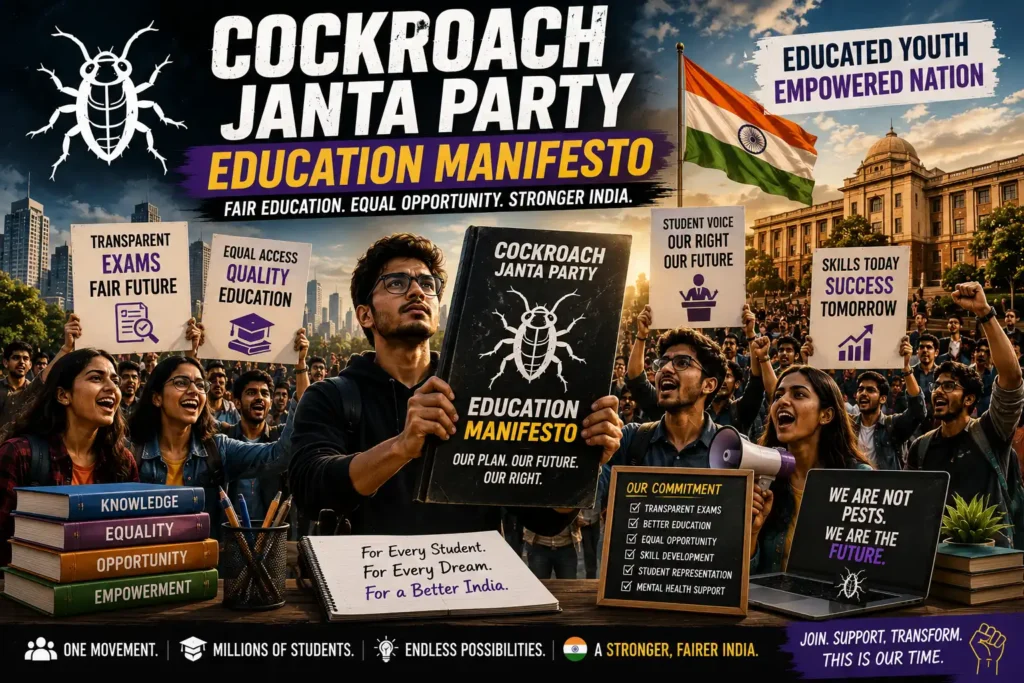
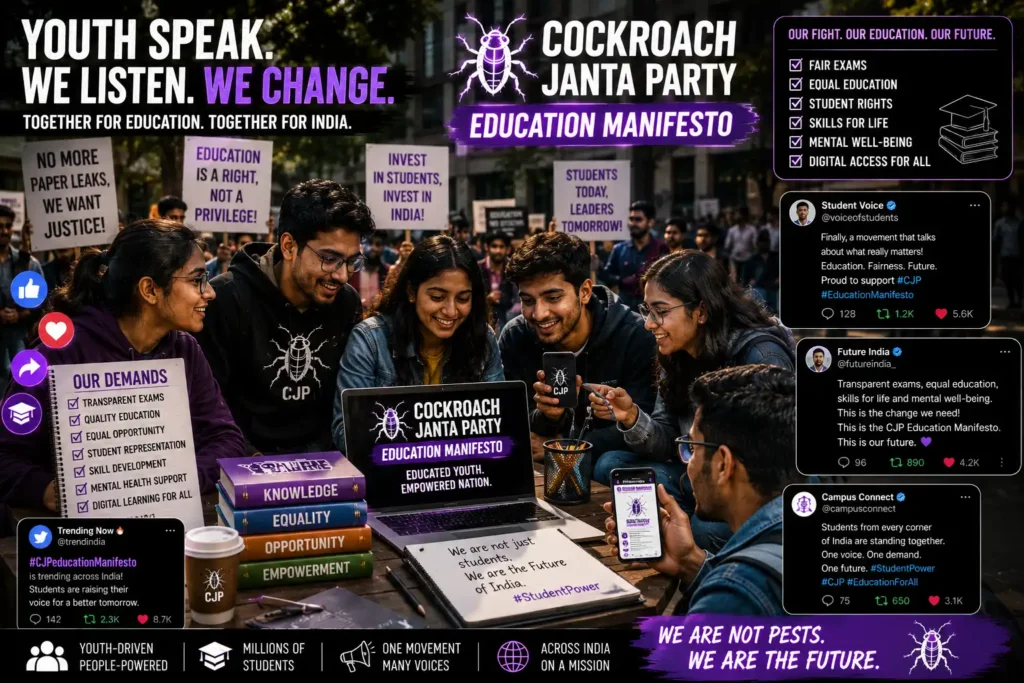
The education manifesto is a dedicated set of proposals focused on improving educational systems, examination processes, and opportunities for students.
Unlike traditional policy documents filled with technical language, the manifesto presents its ideas in a way that young audiences can easily understand.
Its core themes include:
- Education reform
- Exam transparency
- Equal opportunities
- Student representation
- Skill-based learning
- Accountability in educational institutions
These themes reflect conversations already happening across student communities and social media platforms.
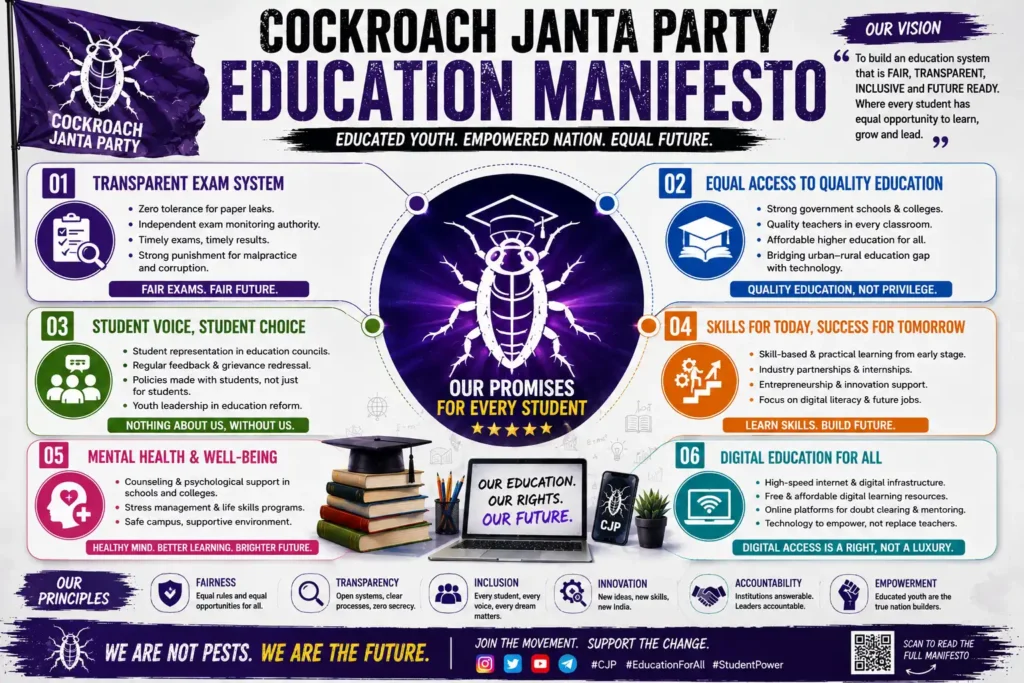
Key Promises In The Cockroach Janta Party Education Manifesto
1. Transparent Examination Systems
One of the manifesto’s strongest demands focuses on examination integrity.
Students often invest years preparing for competitive exams.
When paper leaks or administrative failures occur, the consequences can be devastating.
The manifesto calls for:
- Independent monitoring bodies
- Strong anti-paper leak mechanisms
- Faster investigations
- Transparent result processes
- Public accountability for exam failures
Supporters argue that students should never pay the price for institutional mistakes.
2. Equal Access To Quality Education
Educational opportunities in India can vary significantly depending on geography and economic background.
The manifesto emphasizes reducing these inequalities.
Key proposals include:
- Better infrastructure in government schools
- Improved digital learning access
- Affordable higher education
- Enhanced support for rural students
The goal is to ensure that a student’s future is determined by talent rather than location or financial circumstances.
3. Student Representation In Decision-Making
A unique aspect of the Cockroach Janta Party education manifesto is its emphasis on student participation.
Many educational policies are designed without meaningful student input.
The manifesto proposes:
- Student advisory councils
- Feedback systems
- Greater representation in policy discussions
- Regular consultation mechanisms
This reflects a broader shift toward participatory governance.
4. Skills Over Memorization
One criticism frequently directed at educational systems is the heavy focus on rote learning.
The manifesto advocates for a stronger emphasis on practical skills.
Areas highlighted include:
- Digital literacy
- Entrepreneurship
- Communication skills
- Critical thinking
- Industry-oriented training
Supporters believe these changes would better prepare students for modern careers.
5. Mental Health Support
Education is not only an academic issue.
It is also an emotional one.
Students face increasing pressure from exams, competition, and uncertainty.
The manifesto proposes:
- Counseling services
- Mental health awareness programs
- Stress management support
- Student wellness initiatives
This is one of the most modern aspects of the document and reflects growing awareness around student well-being.
Education Manifesto vs Traditional Education Promises
| Issue | Traditional Political Promises | CJP Education Manifesto |
|---|---|---|
| School Infrastructure | Broad commitments | Direct focus on accessibility |
| Exams | General reforms | Strong emphasis on transparency |
| Student Voice | Limited involvement | Active participation |
| Skills Training | Secondary priority | Major focus area |
| Mental Health | Often overlooked | Explicit inclusion |
| Digital Education | Growing focus | Central pillar |
The comparison highlights why younger audiences may find the manifesto appealing.
It focuses on practical concerns students discuss daily.
Why Gen Z Relates To The Manifesto
The popularity of the education manifesto reveals something important about today’s generation.
Students increasingly want:
- Accountability
- Transparency
- Participation
- Career readiness
Traditional political communication often speaks about education from an institutional perspective.
The Cockroach Janta Party speaks about education from the student’s perspective.
This difference helps explain why the manifesto has gained traction on social media.
Many students see their own experiences reflected in its messaging.
The Exam Transparency Debate
Perhaps no issue receives more attention within the manifesto than exam transparency.
Examinations affect:
- College admissions
- Government job recruitment
- Professional certifications
- Career opportunities
When irregularities occur, public trust suffers.
The manifesto argues that trust can only be restored through:
- Independent oversight
- Open investigations
- Faster corrective action
- Clear communication
Whether one supports the movement or not, these concerns resonate across political lines.
Can Education Reform Alone Solve Youth Frustration?
An interesting question emerges when discussing the manifesto.
Would education reform automatically solve broader youth concerns?
The answer is probably no.
Education, employment, governance, and economic opportunities are interconnected.
However, education remains a critical starting point.
A transparent and effective education system creates:
- Better opportunities
- Stronger workforce development
- Increased social mobility
- Greater public trust
This is why education occupies such a prominent position within the movement’s agenda.
Criticism Of The Education Manifesto
Like any political proposal, the manifesto faces criticism.
Some observers argue:
- Certain proposals lack implementation details.
- Funding mechanisms remain unclear.
- Large-scale reforms require long-term planning.
- Social media popularity does not guarantee policy success.
These criticisms are reasonable.
Creating meaningful educational reform is far more complex than identifying problems.
The real challenge lies in execution.
What The Manifesto Gets Right
Despite criticism, the education manifesto succeeds in several areas.
It Identifies Real Problems
Most of the issues highlighted are widely recognized by students.
It Uses Accessible Language
Young audiences can easily understand the proposals.
It Encourages Discussion
The manifesto has sparked conversations about education that extend beyond political circles.
It Reflects Student Concerns
The proposals are rooted in everyday student experiences rather than abstract policy theory.
Key Takeaways
| Education Priority | Manifesto Goal |
|---|---|
| Exam Transparency | Fair and accountable testing |
| Access To Education | Equal opportunities for all |
| Student Voice | Representation in decisions |
| Skills Development | Career-focused learning |
| Mental Health | Better student support |
| Digital Learning | Improved accessibility |
The Bigger Picture
The Cockroach Janta Party education manifesto is ultimately about more than education.
It reflects a broader demand for fairness.
Students are asking:
- Why are systems failing?
- Who is accountable?
- How can trust be restored?
- What should the future look like?
The manifesto attempts to answer these questions.
Whether it succeeds politically remains uncertain.
But it has already succeeded in starting conversations that matter.
Conclusion
The cockroach janta party education manifesto has become one of the movement’s most influential ideas because it addresses concerns that millions of students experience firsthand.
From exam transparency and equal access to mental health support and skills-based learning, the manifesto presents a vision that resonates strongly with younger audiences.
Some proposals may require further development.
Others may face implementation challenges.
Yet the document’s greatest achievement may be its ability to make education a central topic of public debate once again.
And in a country where education shapes the future of millions, that conversation is worth having.
Internal Links
- What Is Cockroach Janta Party?
- Cockroach Janta Party Manifesto Explained
- Cockroach Janta Party Founder
- Cockroach Janata Party Instagram Growth
What do you think about the Cockroach Janta Party education manifesto?
Do its proposals address the challenges students face today, or are deeper reforms needed?
Share your thoughts in the comments and join the conversation.
Linkedin – CJP