
Cockroach Janta Party Protest: Why This Movement Is Capturing National Attention
The Cockroach Janta Party protest has emerged as one of the most talked-about youth-led movements in India in 2026. What began as a viral online campaign has rapidly evolved into a nationwide protest movement focused on education, examination transparency, accountability, and the concerns of millions of students and job aspirants.
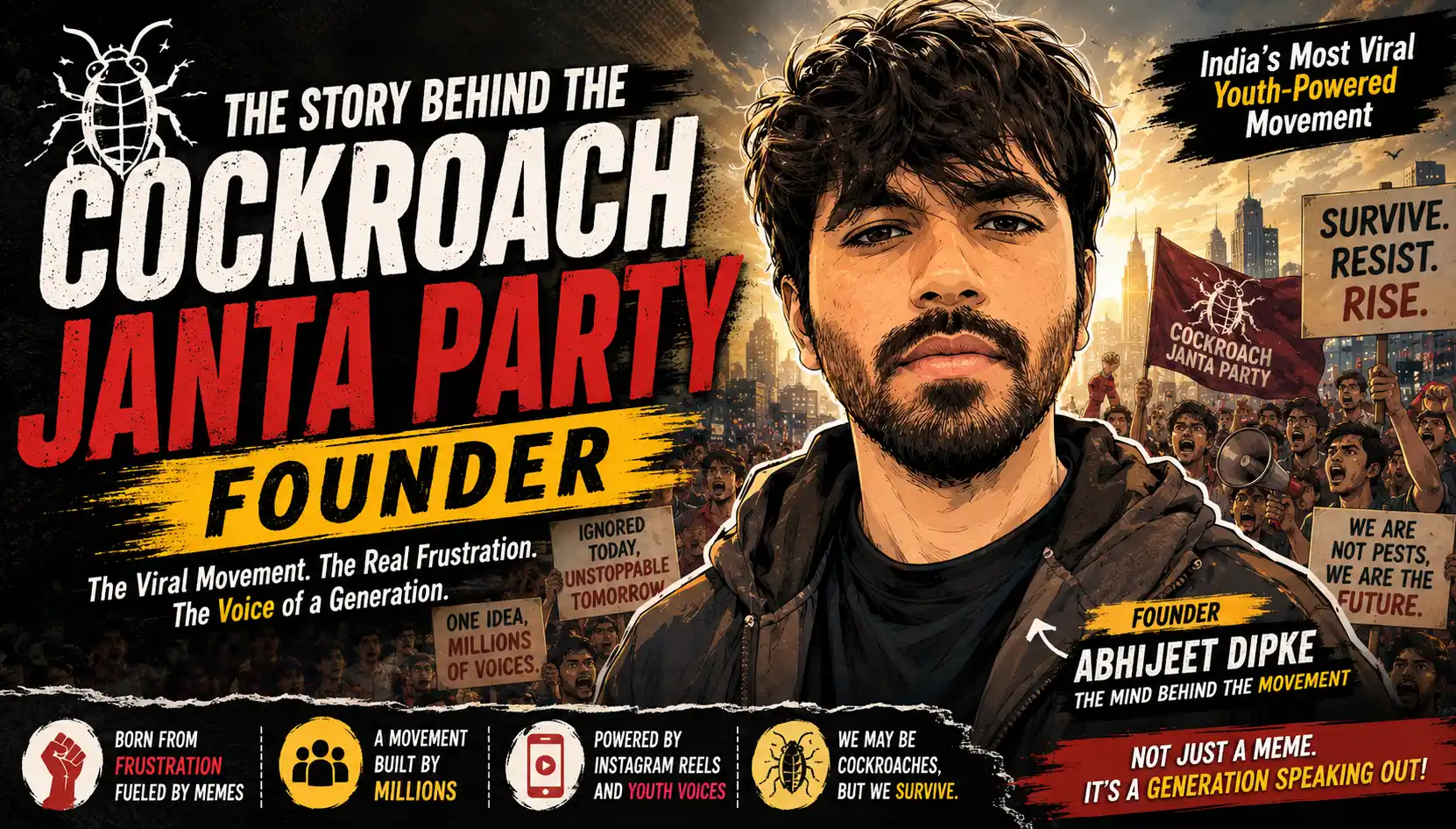
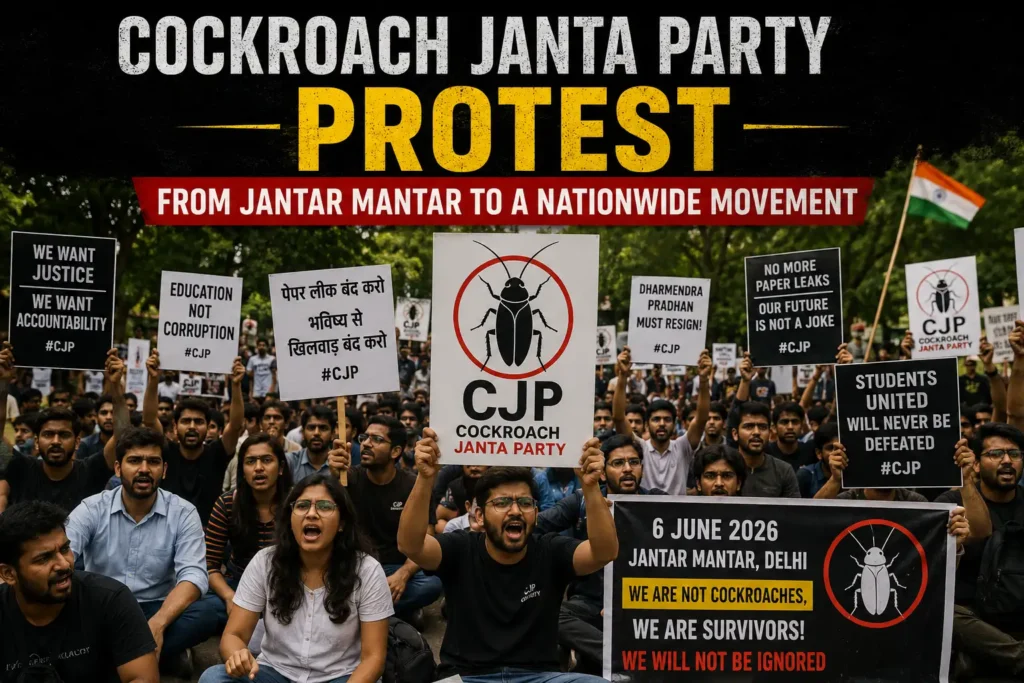
Over the past few weeks, social media platforms have been flooded with discussions about the Cockroach Janta Party (CJP), its founder Abhijeet Dipke, and its growing list of supporters. The movement gained mainstream attention after a large gathering at Delhi’s Jantar Mantar on June 6, where protesters demanded accountability over examination-related controversies and called for the resignation of Union Education Minister Dharmendra Pradhan.
Unlike many internet trends that disappear after a few days, the Cockroach Janta Party protest has continued to grow. The organization has announced a nationwide campaign beginning from Pune, followed by demonstrations in multiple cities across India. It has also warned that if its demands are not addressed, supporters will gather once again at Jantar Mantar on June 20 for an indefinite sit-in protest.
As public interest continues to rise, many people are searching for answers. What exactly is the Cockroach Janta Party? Why are people protesting? What happened on June 6? And what could happen on June 20?
This article explains everything.
What Is the Cockroach Janta Party?
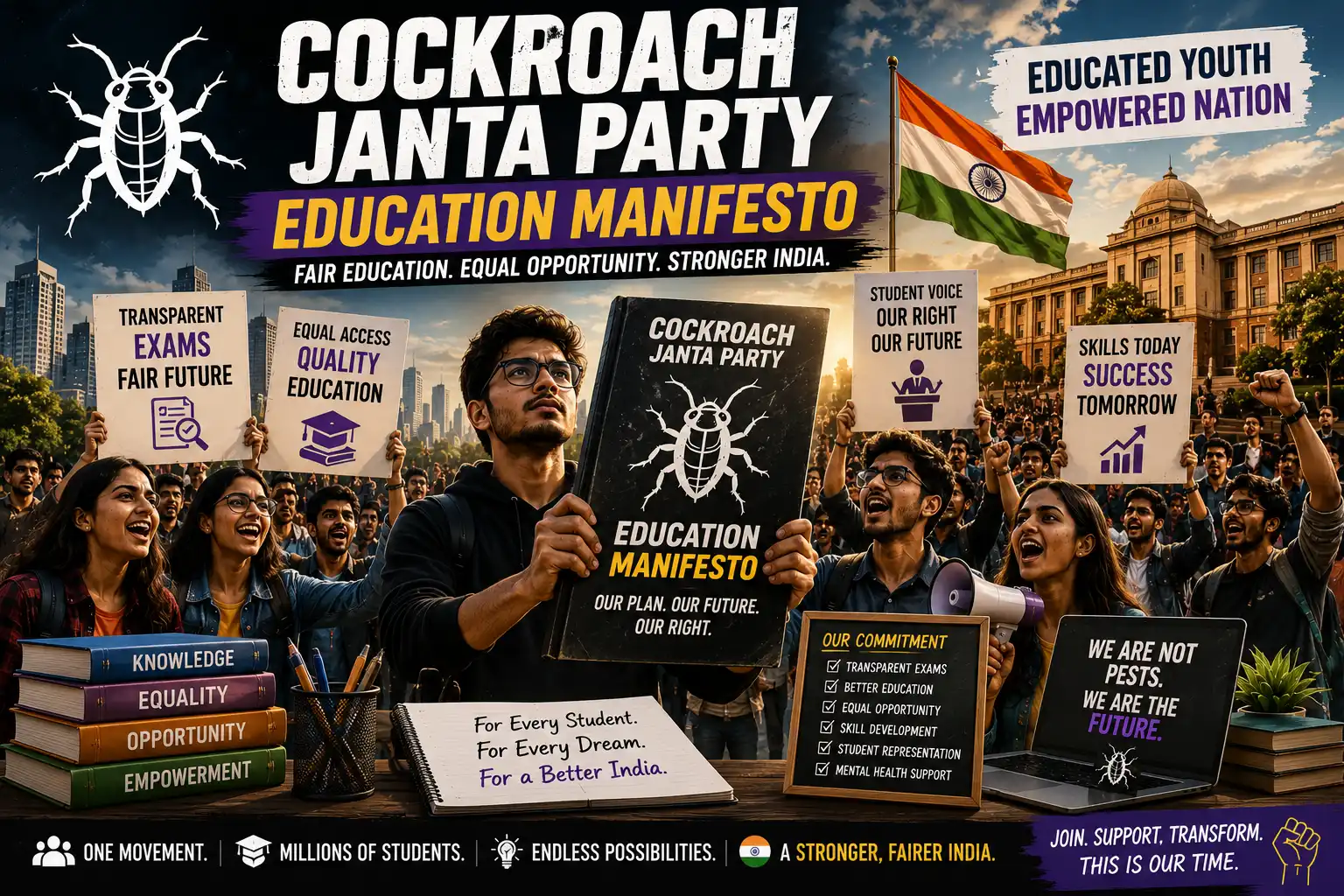
The Cockroach Janta Party, commonly referred to as CJP, is a youth-driven movement that gained popularity through social media before transitioning into real-world activism.
The name itself attracted attention because it combines an unusual symbol, the cockroach, with the idea of a public movement. Supporters explain that the cockroach represents resilience, survival, and persistence. The symbolism reflects the belief that ordinary citizens continue to face challenges while adapting and surviving despite difficult circumstances.
Initially, many observers dismissed the movement as satire. However, its rapid growth demonstrated that it resonated with a large number of students and young professionals.
The movement’s rise has been closely linked to concerns regarding:
- Examination transparency
- Recruitment delays
- Paper leak allegations
- Student welfare
- Accountability within educational institutions
Within a short period, the Cockroach Janta Party built a significant online following and became one of the most discussed youth-led movements in the country.
How the Movement Went Viral
One of the most remarkable aspects of the Cockroach Janta Party protest is how quickly it spread.
Traditionally, political or social movements required extensive organization, local meetings, and years of grassroots campaigning. The internet has changed that reality.
Through social media platforms such as Instagram, X, YouTube, and Facebook, CJP was able to reach millions of users in a matter of weeks.
Several factors contributed to its growth:
Relatable Messaging
The movement focused on issues that directly affect young Indians.
Students preparing for competitive examinations and job aspirants facing uncertainty found the message relatable.
Strong Visual Identity
The cockroach symbol helped the movement stand out in crowded online discussions.
Viral Content
Short videos, graphics, speeches, and protest announcements were widely shared.
Youth Participation
Young people became active participants rather than passive observers.
As a result, the movement expanded beyond the digital world and began organizing physical demonstrations.
Why Is the Cockroach Janta Party Protest Trending?
The protest movement is trending because it taps into concerns shared by millions of students and job seekers.
Many participants argue that recurring examination controversies have created uncertainty and anxiety.
The issues frequently highlighted include:
| Issue | Concern |
|---|---|
| Paper Leak Allegations | Fairness of examinations |
| Recruitment Delays | Career uncertainty |
| Examination Errors | Impact on students |
| Accountability | Responsibility for failures |
| Student Welfare | Mental and emotional stress |
According to supporters, these concerns extend beyond individual incidents and reflect broader systemic challenges.
The movement has therefore positioned itself as a voice for students who feel unheard.
June 6 Jantar Mantar Protest: The Movement’s Biggest Moment
The defining moment for the Cockroach Janta Party protest came on June 6, 2026.
On that day, thousands of supporters gathered at Jantar Mantar in New Delhi.
For many observers, this was the first clear indication that the movement had evolved beyond social media.
The demonstration attracted:
- Students
- Competitive examination aspirants
- Young professionals
- Social activists
- Supporters from multiple states
Participants carried banners, placards, flowers, and copies of the Constitution while emphasizing peaceful protest.
The gathering received widespread media coverage and became one of the most discussed political events of the week.
Why Jantar Mantar Matters
Jantar Mantar is one of India’s most well-known locations for public demonstrations.
Over the years, it has hosted countless movements related to:
- Corruption
- Social justice
- Education
- Employment
- Governance
By choosing Jantar Mantar, organizers positioned the Cockroach Janta Party protest within India’s broader democratic tradition of peaceful public dissent.
The symbolism was significant.
The movement was no longer confined to hashtags and social media trends. It had entered the national political conversation.
The Demand for Dharmendra Pradhan’s Resignation
One of the central demands raised during the June 6 protest was the resignation of Union Education Minister Dharmendra Pradhan.
According to organizers, the demand stems from concerns about examination management and accountability.
Protesters argue that repeated controversies involving examinations have undermined confidence in the system.
Supporters believe responsibility should extend to senior leadership rather than remaining limited to lower administrative levels.
At the same time, it is important to note that these allegations and demands remain politically contested, and government representatives have not accepted the protesters’ position.
Nevertheless, the demand has become a key rallying point for the movement.
What Protesters Are Asking For
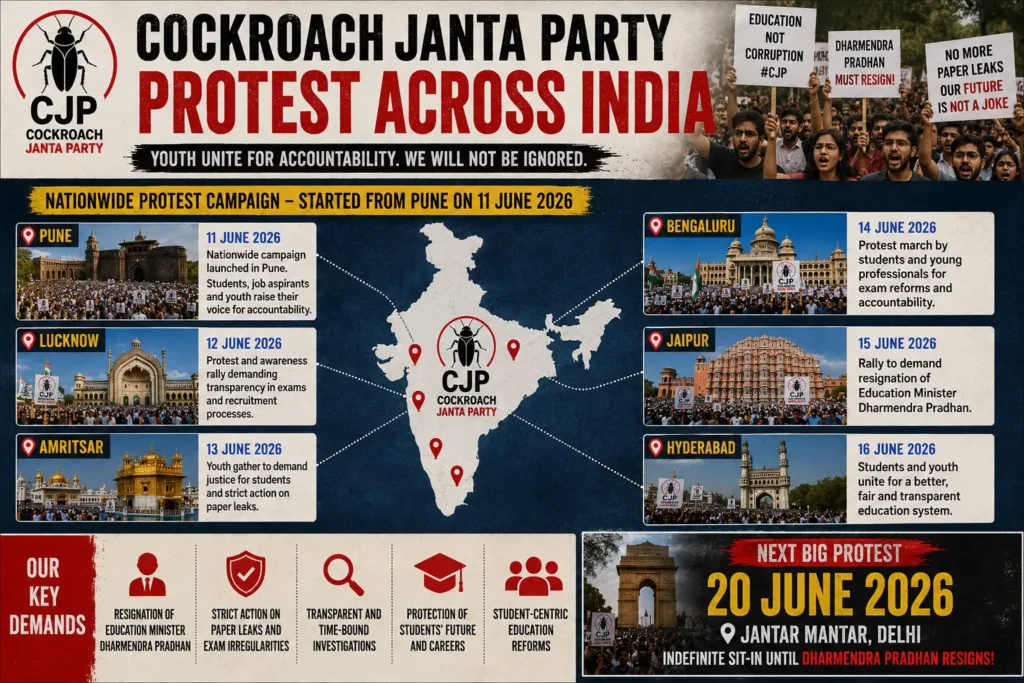
Although public attention often focuses on the resignation demand, the movement’s agenda extends beyond a single individual.
Supporters say they want broader reforms.
Some of the issues highlighted include:
Greater Examination Transparency
Participants want examination processes to be more transparent and accountable.
Stronger Security Measures
Many supporters advocate stronger safeguards to prevent future controversies.
Faster Resolution of Complaints
Students often complain about delays in addressing examination-related grievances.
Improved Accountability
Organizers argue that clear accountability mechanisms should exist whenever major failures occur.
Student-Centric Reforms
The movement emphasizes policies that prioritize the interests of students and job aspirants.
These demands have helped the protest gain support among people who may not necessarily agree with every political aspect of the campaign but share concerns about educational reforms.
Sonam Wangchuk’s Support Brings National Attention
The movement received additional visibility when activist Sonam Wangchuk expressed support for the June 6 demonstration.
His involvement attracted national attention and introduced the movement to audiences who may not have been following it previously.
For supporters, his participation represented validation of the issues being raised.
For critics, it highlighted the growing influence of the movement.
Regardless of perspective, Wangchuk’s involvement increased public awareness and contributed to broader discussions about education and accountability.
June 11 Pune Protest: The Beginning of a Nationwide Campaign
Following the June 6 demonstration in Delhi, the Cockroach Janta Party announced the second phase of its movement.
On June 11, the organization officially launched a nationwide protest campaign from Pune. The event marked a strategic shift from a single-city protest to a coordinated national effort.
According to party representatives, the objective of the campaign is to engage directly with students, job aspirants, parents, educators, and citizens who have concerns regarding examination systems and accountability.
The Pune gathering served several purposes:
- Expanding the movement beyond Delhi
- Building state-level volunteer networks
- Raising awareness about educational issues
- Presenting reform proposals
- Mobilizing support for future demonstrations
For organizers, Pune was viewed as an ideal starting point because of its large student population and strong educational ecosystem.
The event attracted supporters from Maharashtra and neighboring states, signaling that the movement’s reach was expanding.
CJP’s Exam Reform Agenda
During the Pune campaign, leaders of the movement attempted to shift the conversation beyond protest slogans and present a reform-focused narrative.
Supporters argue that criticism alone is not enough. They believe long-term solutions are needed to restore confidence in examination systems.
Several recurring themes emerged during campaign speeches:
Examination Security
Many participants stressed the need for stronger safeguards to prevent future controversies.
Transparent Investigations
Supporters argued that whenever examination-related disputes occur, investigations should be conducted transparently.
Student Protection
The movement has repeatedly emphasized that students should not bear the consequences of administrative failures.
Faster Resolution Mechanisms
Candidates often face uncertainty for months when controversies arise.
Many participants believe timelines for resolution should be clearly defined.
Accountability Frameworks
The movement argues that responsibility should be clearly established whenever systemic failures occur.
These themes have become central to the Cockroach Janta Party protest narrative.
Cities Scheduled for Upcoming Demonstrations
One reason the movement continues to attract attention is its ambitious nationwide expansion plan.
Organizers have announced demonstrations in several major cities.
Planned Protest Locations
| City | Focus Area |
|---|---|
| Pune | Nationwide campaign launch |
| Lucknow | Student outreach and awareness |
| Amritsar | Public engagement campaign |
| Bengaluru | Youth participation event |
| Jaipur | Accountability demonstration |
| Hyderabad | Student solidarity gathering |
The choice of multiple cities reflects an effort to build a broader coalition rather than relying solely on supporters from one region.
For organizers, national visibility is critical to sustaining momentum.
For observers, the scale of the expansion will be an important indicator of the movement’s future influence.
Why Students Are Joining the Movement
One of the most notable aspects of the Cockroach Janta Party protest is the demographic composition of its supporters.
Unlike traditional political protests dominated by established party structures, much of the movement’s support appears to come from younger Indians.
Several factors explain this trend.
Examination Pressure
Competitive examinations play a major role in shaping career opportunities.
Many students spend years preparing for a single exam.
When controversies arise, uncertainty can have significant consequences.
Employment Concerns
Youth unemployment remains a major concern for many graduates.
Participants frequently connect examination issues with broader questions about career opportunities.
Digital Mobilization
Young people are highly active on social media platforms.
This makes it easier for movements like CJP to reach large audiences quickly.
Shared Experiences
Many participants feel that the concerns being raised reflect experiences they have personally encountered.
This creates a strong sense of community and collective purpose.
Social Media’s Role in the Protest
The rise of the Cockroach Janta Party protest would have been difficult to imagine without social media.
The movement demonstrates how modern activism increasingly combines online engagement with offline action.
Several characteristics have contributed to its digital success:
Fast Communication
Announcements can reach supporters instantly.
Viral Content
Short videos and graphics are widely shared.
Community Building
Supporters can connect with others who share similar concerns.
National Reach
Messages can spread far beyond the geographic location of any single protest.
Media Amplification
Online discussions often attract mainstream media coverage.
This combination has allowed the movement to grow at an unusually rapid pace.
June 20 Jantar Mantar Sit-In: The Next Major Test
Perhaps the most significant upcoming event for the movement is the planned June 20 gathering at Jantar Mantar.
According to statements made by party founder Abhijeet Dipke, supporters from across the country are expected to assemble in Delhi if the movement’s demands remain unmet.
Organizers have described the proposed action as an indefinite peaceful sit-in protest.
The announcement has generated widespread interest because it represents an escalation from symbolic demonstrations to sustained public pressure.
If large numbers of supporters attend, the event could become one of the most significant youth-led protests of the year.
Several questions remain unanswered:
- How many participants will attend?
- Will demonstrations remain peaceful?
- How will authorities respond?
- Will the movement sustain momentum after June 20?
The answers could shape the future trajectory of the campaign.
Public Reaction: Supporters and Critics
As the movement grows, public opinion remains divided.
Supporters Argue
Many supporters believe the movement is giving students a platform to express legitimate concerns.
They argue that:
- Accountability is necessary.
- Educational reforms are overdue.
- Peaceful protest is a democratic right.
- Students deserve greater transparency.
For supporters, the movement represents a broader demand for institutional responsibility.
Critics Argue
Critics have raised different concerns.
Some argue that:
- Complex issues cannot be solved through slogans.
- Social media can oversimplify policy debates.
- Viral movements often struggle to maintain momentum.
- Protests should be accompanied by detailed policy solutions.
These debates are likely to continue as the movement evolves.
The Political Significance of the Movement
Regardless of political views, the Cockroach Janta Party protest has become a significant case study in modern political communication.
Several factors make it noteworthy:
Youth-Led Participation
Young people are driving the conversation.
Digital First Strategy
The movement grew online before transitioning into street protests.
Decentralized Structure
Supporters participate across multiple locations.
Issue-Based Messaging
The campaign focuses heavily on education and accountability.
Rapid Growth
Few recent movements have expanded so quickly.
Political analysts are closely watching whether the movement can translate public attention into lasting influence.
What Happens After June 20?
The future of the movement may depend heavily on events surrounding the June 20 sit-in.
Several scenarios are possible.
Scenario 1: Continued Expansion
If turnout remains strong, organizers could continue building a nationwide network.
Scenario 2: Policy Engagement
The movement could shift toward dialogue and policy advocacy.
Scenario 3: Electoral Influence
Although currently focused on activism, some observers speculate that the movement could eventually explore a more formal political role.
Scenario 4: Reduced Momentum
Like many protest movements, public attention could gradually decline if objectives are not achieved.
At this stage, predicting the outcome remains difficult.
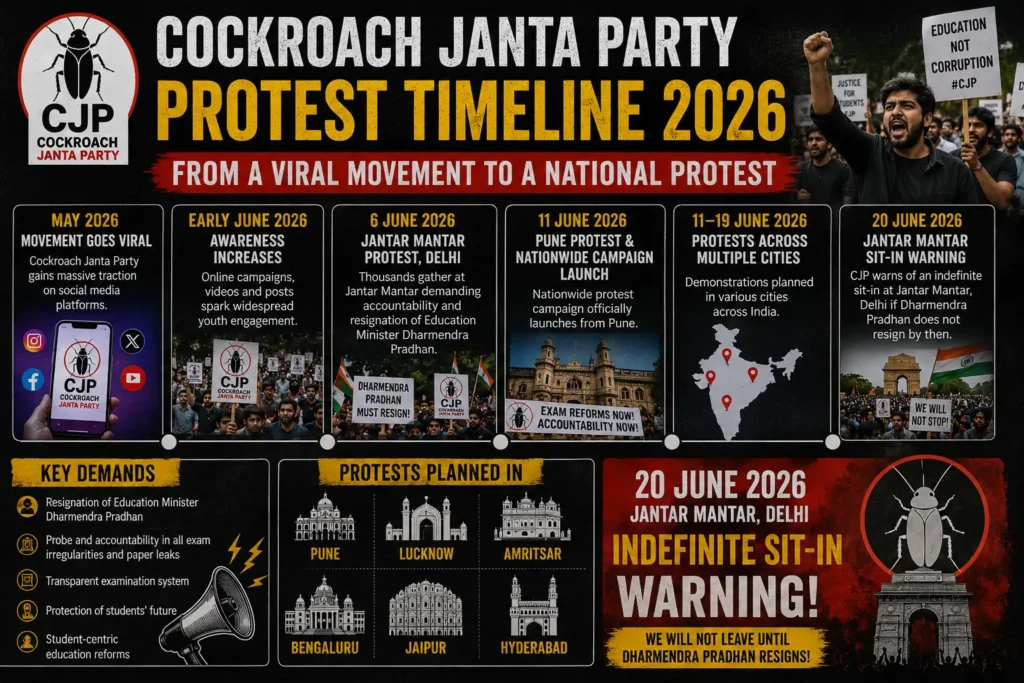
Timeline of the Cockroach Janta Party Protest
| Date | Event |
| May 2026 | Movement gains traction online |
| Early June 2026 | National media attention increases |
| June 6, 2026 | Major protest held at Jantar Mantar, Delhi |
| June 11, 2026 | Nationwide campaign launched from Pune |
| June 15, 2026 | Jaipur demonstration planned |
| June 20, 2026 | Proposed indefinite sit-in at Jantar Mantar |
This timeline illustrates how rapidly the movement has developed in a matter of weeks.
Key Takeaways
Before concluding, here are the most important points readers should understand about the Cockroach Janta Party protest:
- The movement began online and evolved into a national protest campaign.
- Students and young professionals form a large portion of its support base.
- The June 6 Jantar Mantar protest marked a major turning point.
- Protesters are demanding accountability and educational reforms.
- A nationwide campaign was launched from Pune on June 11.
- Demonstrations are planned in multiple cities.
- June 20 could become the movement’s most important event so far.
- Public opinion remains divided, but interest continues to grow.
Conclusion
The Cockroach Janta Party protest has become one of the most closely watched youth movements in India in 2026.
What started as a social media phenomenon has evolved into a nationwide campaign focused on education, accountability, and student concerns.
From the June 6 protest at Jantar Mantar to the nationwide campaign launched from Pune and the proposed June 20 sit-in, the movement has demonstrated an ability to mobilize supporters across multiple cities.
Whether the movement ultimately achieves its objectives remains uncertain.
However, it has already succeeded in bringing discussions about examination systems, transparency, accountability, and student welfare into the national spotlight.
As India watches developments unfold, one thing is clear: the Cockroach Janta Party protest has become much more than an internet trend. It has become a significant part of the country’s ongoing conversation about education, opportunity, and democratic participation.
Frequently Asked Questions (FAQ)
What is the Cockroach Janta Party protest?
The Cockroach Janta Party protest is a youth-led movement focused on issues such as examination transparency, accountability, student welfare, and educational reforms.
Why are protesters demanding Dharmendra Pradhan’s resignation?
According to organizers, the demand is linked to concerns regarding examination management and accountability. The issue remains politically contested.
What happened on June 6 at Jantar Mantar?
Thousands of supporters gathered at Jantar Mantar in Delhi for a peaceful demonstration that brought national attention to the movement.
What is planned for June 20?
The organization has announced an indefinite peaceful sit-in at Jantar Mantar if its demands are not addressed before that date.
Which cities are hosting protests?
Demonstrations have been announced in Pune, Lucknow, Amritsar, Bengaluru, Jaipur, Hyderabad, and other locations.
Why is the movement attracting young people?
Many supporters believe it addresses issues that directly affect students, job seekers, and young professionals, including examination transparency and career uncertainty.
Read More Article
- What Is Cockroach Janta Party?
- Cockroach Janta Party Meaning
- Origin of Cockroach Janta Party
- Timeline of Cockroach Janta Party
- Why Is Cockroach Janta Party Trending?
- Complete Guide to Cockroach Janta Party